Re: based GNUnet decentralized IP address, Abolish ipv4 and ipv6
Christian Grothoff <[email protected]> Wed, 13 Dec 2023 15:07:51 +0900
| Newsgroups | gmane.network.gnunet.devel |
|---|---|
| Organization | GNUnet e.V. |
| Message-ID | <[email protected]> |
Dear aiss, GNUnet already uses public keys for addressing and routing in the CORE/DHT/CADET layers (and above), effectively replacing IP addresses that are created in a decentralized way. Only the transport layer which adapts the protocol to run over existing Internet connections we have IP addresses. However, it is possible to write communicators for the transport layer that do not use IP at all, for example by directly using Ethernet/WLAN and bypassing TCP/IP entirely. Happy hacking! Christian On 12/11/23 16:04, aiss wrote: > THE IDEAL PATH > What if we replace the controlled and surveilled IP addresses with new > internet addresses that are based on GNUnet? These addresses will > inherit all GNUnet’s features, i.e., they will be purely decentralized, > secure, future-proof, robust, anonymous, unhackable, controlled by no > single authority and many more. > > Is it just a dream? For now. If this could be true we would be changing > the internet as we know it. > > * GNUnet address + GNUnet DNS, access to GNUnet domain > > win10 network adapters : Enter the GNUnet address > Wi-Fi DHCP Static : Enter the GNUnet address > > > --- > IPv4 and IPv6 are centralized. They are controlled by national > companies, etc. > 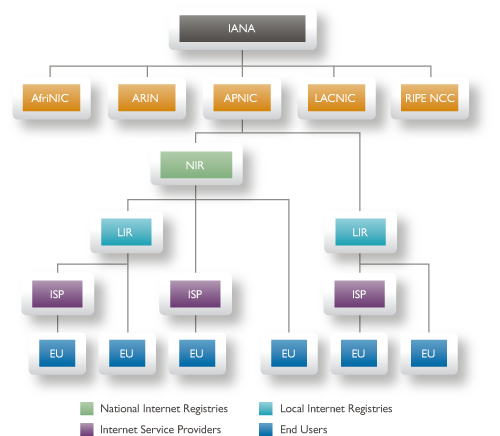 > > Try to Google “Who controls IP addresses?” You’ll promptly get “IANA: > the Internet Assigned Numbers Authority.” IANA is the top authority > behind IP address allocation and assignment. There are five different > regional internet registries (RIR) with jurisdiction under the IANA. > > As a matter of fact, as an individual or a normal internet user you > cannot request IP addresses directly from IANA or one of the five RIRs, > but only from internet service providers, such as the services offered > by mobile or telecom operators. > > > * True decentralization, no official singular Foundation, Committee, > Corporation, or entities in permanent unitary control of the protocol. > > > > > >